This just in! From upcoming Dolce events and delicious recipes to company news and information on allergy awareness, the latest headlines all land here. Check them out below…
We can finally fix it: Why it’s time to overhaul the Free School Meal model
By Adam Curtis, Director at Dolce
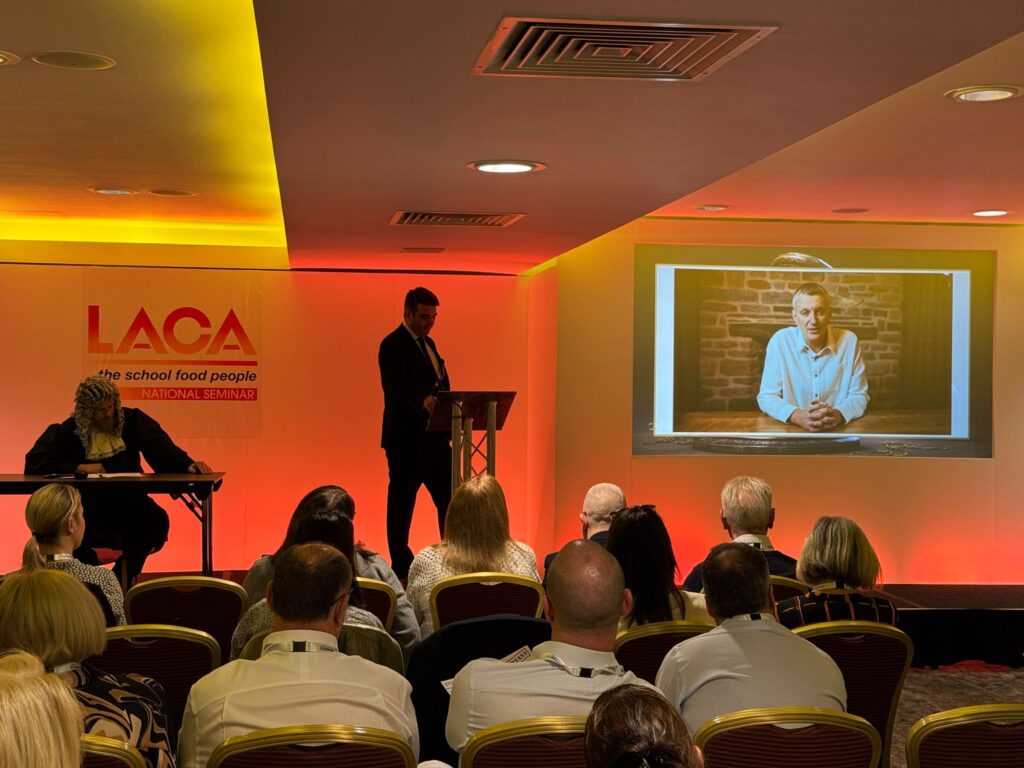
Last week at the LACA Autumn Seminar, our Dolce team had the chance to stand in front of colleagues from across the catering and hospitality sector and talk openly about something that has been broken for more than a decade: the way Free School Meals are funded.
This isn’t a new conversation for us at Dolce. We’ve been calling for change for years. But the urgency has never been greater – and for the first time, we believe things are finally heading in the right direction.
A model frozen in time
When Universal Infant Free School Meals were introduced 11 years ago, the meal allocation was set at £2.30 per child. Crucially, every school, regardless of size, was given the same amount per meal.
At first glance, it looked fair. In reality, it doesn’t work.
Catering is built on economies of scale. A large school can deliver meals far more efficiently than a small rural school. Yet both schools were funded at the same rate. That mismatch triggered a domino effect:
The fixed £2.30 was too high for large schools, whose costs per meal were often much lower.
It was far too low for small schools, whose kitchens were more expensive to run per pupil.
Many Local Authority (LA) catering services simply couldn’t make the numbers work – and as a result we’ve seen many have to fold their catering services all together.
Some caterers, including us, were able to offer large schools a cheaper meal price – sensible for their budgets, but it left LA’s with an even smaller base of schools to fund.
As more big schools exited LA services, the remaining small schools were left with spiralling costs. The system became untenable for everyone.
And here’s the crucial point: Increasing the fixed meal price alone won’t fix this.
Even if funding rose to £4 per meal, small schools would still be forced to subsidise their provision, while larger schools would profit from a level of funding they simply don’t need.
The system is flawed at its core – not just underfunded.
A new model: Fair, scalable, future-proof
At Dolce, we’ve spent years calling for a new way of funding school meals – one that recognises the realities of catering economics and distributes funding fairly.
Our proposal is simple, logical and widely supported: A fixed subsidy and a variable subsidy. For example: £20,000 fixed sum for every school with a £2 per meal variable funding.
This ensures:
Small and rural schools receive enough to run a viable catering service.
Local Authorities can continue to sustainably serve their communities.
Caterers have confidence to increase investment and improve food quality.
Most importantly, every child benefits.
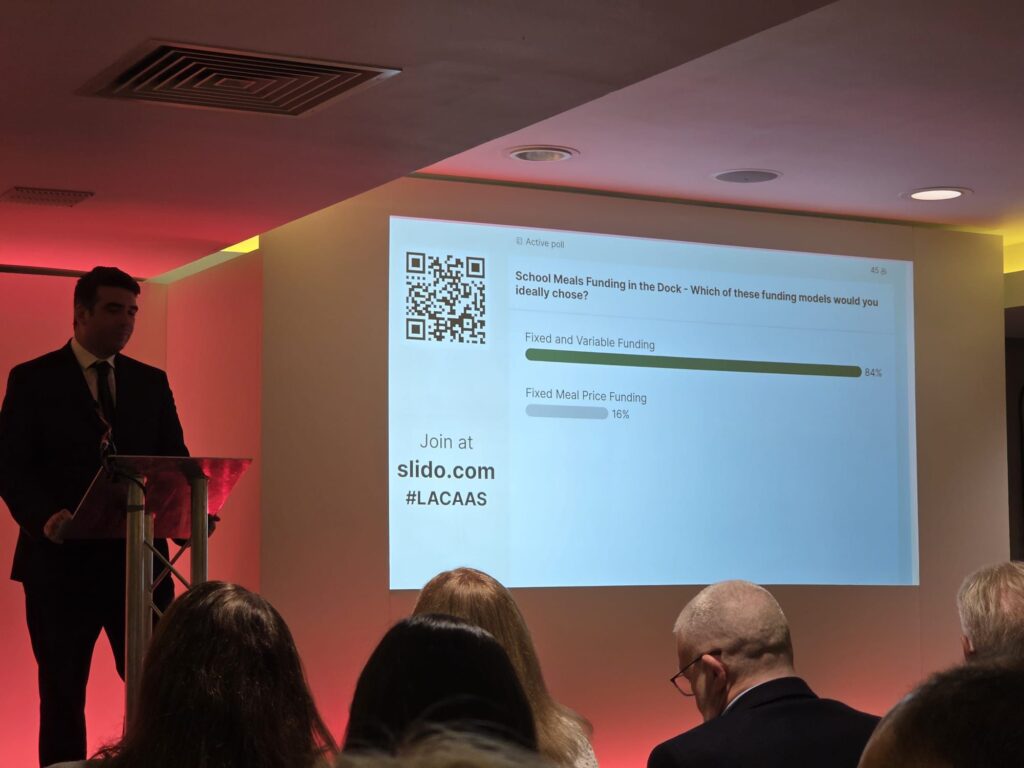
This is the direction we need – and last week at LACA, sector colleagues made their view clear. Attendees were asked to vote on the proposed fixed-plus-variable model – and 84% voted in favour. That is an unprecedented mandate for change.
Why this matters now
By September 2026, the Free School Meal eligibility threshold is set to expand to include all households on Universal Credit.
This is a brilliant and positive step – but only if the funding model is fit for purpose. Extending entitlement without fixing the mechanism behind it risks repeating the mistakes of 2013 at even greater scale. The new model needs to be in place before this expansion takes effect. And that window is closing fast.
We need your voice
We spoke at LACA because we cannot solve this alone. We’re calling on schools to raise this with their DfE contacts, Local Authorities to engage and share their insights, catering teams to contribute evidence and support and everyone in the sector to keep this conversation visible – at events, on social media, in professional networks.
If this model is adopted, the benefits will be felt across the entire ecosystem. Every small school in England could afford a sustainable, high-quality catering provision. Caterers could serve more schools and invest more in food and Local Authorities could continue to support schools without the financial strain. Pupils – the reason any of us do this – would receive better meals, consistently
For the first time in more than a decade, we have a genuine opportunity to fix a system that has been failing schools since the day it was introduced.
We’re excited to announce that we’ve been named in the top three of the ProVeg UK Contract Caterer Ranking 2025/26, cementing our position as one of England’s most plant-forward and planet-friendly school caterers. Now in its second year, ProVeg UK’s Contract Caterer Ranking recognises contract caterers that put health and sustainability at the heart of […]
Dolce has earned another Silver award for their ProVeg school menus in 2026, recognising their dedication to healthy, planet-friendly meals children enjoy across the UK.